I get this question often: Content writing is content writing, right? Well, that’s partially true, because content writing is a whole empire within which you’ll come across smaller empires like copywriting, creative writing, script writing and more. Still, in general, one can associate the term “content writing” with website content, including landing pages, blogs, and policy pages – more precisely known as SEO writing.
So, let’s cut to the chase. What’s the difference between content writing and copywriting? The difference between the two lies in their purpose. Content writing “informs,” “educates,” and “entertains,” to rank a website’s page on search engine results. Copywriting “convinces,” the user to take a particular action.
Let’s discuss content writing vs copywriting in more detail.
What is Content Writing?
Definition
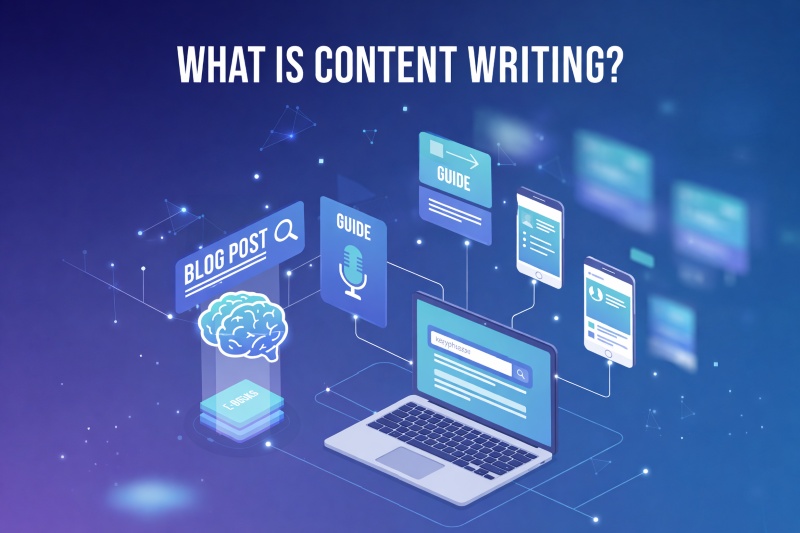
Content writing, in simple terms, provides information. It answers questions or concerns and explains concepts people are trying to understand. It gives clarity where confusion exists. And, not to forget, content writing helps users before trying to sell them anything.
Core Purpose
Content marketing services focus on informing first, not solely on persuading a user to buy something. The idea is pretty simple. Educate the reader well enough that trust forms naturally. When accuracy matters, content becomes the foundation of credibility.
Strong content positions a brand as knowledgeable in its particular niche. This boosts credibility and authority, which are the core elements to winning a user’s trust.
What Content Writing Aims to Achieve?
- Educate readers using clear explanations and real context
- Build authority around a specific subject or industry
- Improve organic visibility through relevant search queries
- Answer real questions users type into search engines
- Establish long-term trust instead of quick wins
Common Formats of Content Writing
- Blog posts and long-form articles
- Industry guides and explainers
- Knowledge base articles
- Case studies and research pieces
- Thought leadership content
How Content Writing Is Used in Marketing?
Content writing plays a key role at the top and middle of the buyer journey. You don’t expect a reader to be ready to make a purchase. Instead, they’re trying to understand a problem, learn terminology, or explore their options.
Content meets them at that stage, not to pressurize them, but to offer solutions that actually work. So, providing value matters more than conversions when we’re talking about content.
Tone and Style
When you’re writing content, the tone has to be clear, conversational and helpful. Sentences need to be direct and readable, and they should be backed by claims that rely on proven, up-to-date stats, facts, examples, and images. In simple words, the content has to be engaging because no one wants to read essays.
SEO and Content Writing
To ensure people read your content, you need to list it on a platform that provides clear direction. These platforms, called search engines, reward content with a higher rank only when it fully answers queries. Content writing targets search intent, topic depth, and relevance.
Content Writing in Professional Services
Service based business like law firms, consultants, and B2B service providers need content heavily. A writer writes guides that explain laws, processes, risks, and compliance rules. So, ultimately, it’s about building trust through delivering knowledge. Additionally, high-quality content builds your authority in that specific niche.
What Content Writing Is Not
- Content writing does not push aggressive calls to action.
- It does not rely on emotional pressure.
- Sales language is minimal.
- The reader decides the next step.
- Content writing lays the foundation.
Example:
The article you’re reading right now is a prime example of content writing. I’m not trying to sell anything… well, maybe… If you like my writing, um… I guess, you can stumble across my LinkedIn and… You know… So, yeah, it’s all about providing information. I guess.
You can also read: SEO Vs PPC: Which is Better?
What Is Copywriting?
Definition
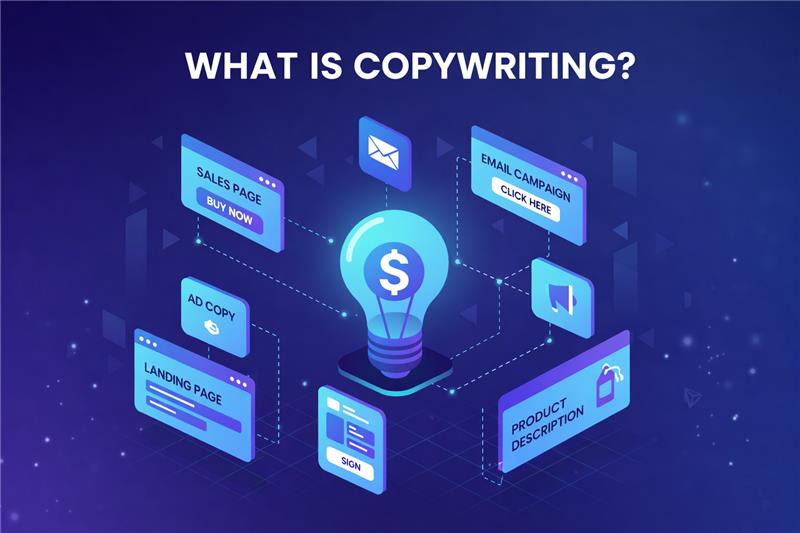
Copywriting is a subdomain of content writing that has a persuasive tone. Unlike content writing, copywriting is not solely about providing information. A copywriter persuades a reader to take a specific action. It’s all about convincing power and giving the reader different reasons to take an action.
In simple terms, copywriting focuses on influencing how a user thinks and what they do next. Every word serves a purpose, and every sentence pushes the reader closer to taking an action.
Core Purpose
The purpose of copywriting is action. It influences decisions, removes hesitation, and encourages the reader to act. This action could be filling out a form, signing up for a service, clicking a button, or making a purchase.
Copywriting speaks directly to intent. The user already understands the problem. Now they need a reason to choose you.
What Copywriting Aims to Achieve
- Influence user decisions at the right moment
- Trigger immediate action
- Convert readers into leads or customers
- Reduce hesitation and objections
- Guide users toward a specific outcome
Typical Goals of Copywriting
- Higher conversion rates
- Increased sales
- Improved click-through rates
- Stronger lead generation
- Better campaign performance
Common Copywriting Formats
- Landing pages
- Sales pages
- Website copy
- Paid ad copy
- Email campaigns
- Product descriptions
- Calls to action
How Copywriting Is Used in Marketing
Copywriting works best at the bottom of the funnel. The reader already knows what they want. They’re comparing options and deciding who to trust.
This is where clarity, confidence, and persuasion matter. Copywriting does not explain everything, but highlights what matters most and removes friction from the decision-making process.
Tone and Style
A copywriter has to write directly, confidently and persuasively. There’s really no room for lengthy texts, since users don’t want to spend much time reading. See this, I’m writing long-form content, and you’re already bored, but I’m going anyway because I’m not intending to sell anything… well, maybe.
The point is, your audience is impatient. So, short sentences, an eye-catching hook, a clear CTA and most importantly, a clear value proposition are what you should be going for.
Copywriting and Results
If you ever want to know if your copywriting skills are great or if you should be promoted to a customer, check the conversion rate. If your audience isn’t signing up, making purchases, or taking the desired action, then…I hate to break it to you, my friend, but you need political skills. Unlike content writing, success here is immediate and measurable.
What Copywriting Is Not
- Copywriting is not long explanations.
- It does not aim to provide deep education.
- It does not wait for trust to build over time.
Example:
Social media captions, PPC landing pages and Emails are all part of copywriting.
Content Writing vs Copywriting: Side-by-Side Comparison
Aspect | Content Writing | Copywriting |
Primary Purpose | Educates, informs, and explains topics clearly | Persuades the reader to take a specific action |
Main Goal | Build trust and authority over time | Drive conversions and immediate results |
Reader Intent | Research and learning | Decision making and action |
Stage in Buyer Journey | Awareness and consideration stage | Decision and conversion stage |
Tone | Neutral, informative, and helpful | Direct, confident, and persuasive |
Depth of Content | In-depth explanations and detailed coverage | Focused messaging with only essential information |
Length | Usually long form | Usually short and concise |
Call to Action | Soft or minimal | Strong and clearly defined |
SEO Focus | Search intent, topical authority, long term rankings | Conversion-focused keywords and user intent |
Performance Measurement | Traffic, engagement, time on page, rankings | Clicks, leads, sales, and conversion rates |
Longevity | Long-lasting value over months or years | Short-term impact tied to campaigns |
Examples | Blogs, guides, FAQs, knowledge base articles | Landing pages, ads, email campaigns, sales pages |
Content Writing VS Copywriting: 7 Key Differences
1. Purpose: Educate vs. Persuade
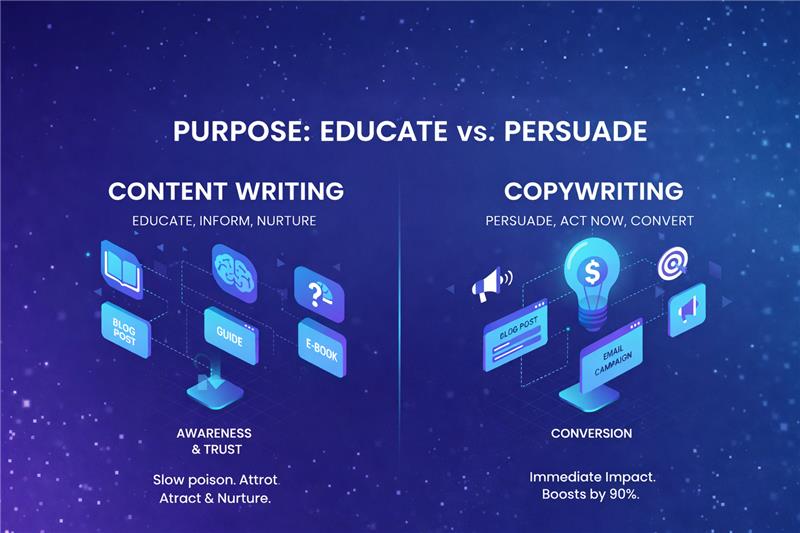
The biggest and most foundational difference between content writing and copywriting is their purpose. Content writing, as we discussed above, is meant to educate, inform, and sometimes entertain readers without a direct push to buy. It’s that simple.
On the other hand, copywriting exists primarily to persuade a reader to act now, like clicking a button, signing up for a demo, or purchasing a product. Research shows that Large B2B companies outsource about 75% of their content writing.
So, to all content writers who’re good with spellings, grammar and technicality – congrachulashens! You have a bright future ahead.
Content writing works like slow poison. It steadily hunts its prey. In marketing terms, I mean attracting and nurturing audiences, and setting a foundation that copywriting then leverages for conversion.
On the other hand, compelling copy has a measurable impact on action; compelling CTAs alone can boost conversion rates by up to 90% when optimized properly. These stats show how fundamentally different the goals of each discipline are in practice.
2. Buyer Journey Placement: Early vs. Later Stages
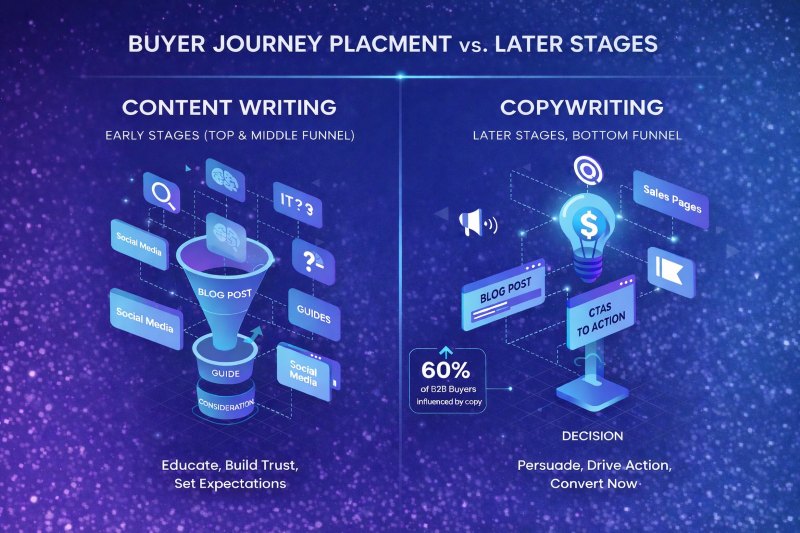
The second key difference is where each domain fits in a buyer’s journey. Content writing is part of the top and middle of the funnel and mainly includes blog posts like “What is…” or topic guides.
These pieces attract users who are exploring options or learning the basics. This is where emotional triggers, benefit framing, and urgent language matter most. They set expectations and position a brand as credible before a purchase decision even comes into play.
Copywriting, on the other hand, lives at the bottom of the funnel, engaging users who are closer to action. Its job isn’t to inform but to ensure the reader takes an action.
According to behavioral data, a clear and engaging copy message influences the decisions of 60% of B2B buyers more than brand reputation does, meaning the right persuasive language can make or break conversions.
3. Length and Depth: Long Form vs. Short Form
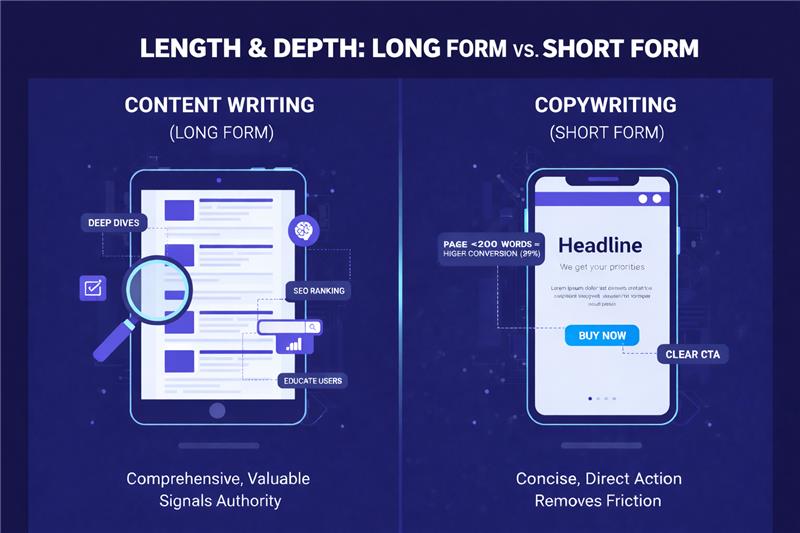
When it comes to structure and length, content writing and copywriting take very different approaches. Content writing generally demands longer forms of writing that dive deep into a topic, often spanning 1,500 words or more to thoroughly cover all relevant user questions and themes.
Long-form content is not only educational but also signals to search engines that the material is comprehensive and valuable, and that’s the key criterion for ranking well.
Copywriting behaves differently. It thrives on concise, tightly focused text that gets readers to act without unnecessary explanation. In many cases, just a few sentences or a single paragraph is enough to persuade a reader when the objective is clear.
Indeed, research shows that pages with fewer than 200 words can have higher average conversion rates because they remove friction and focus entirely on the CTA rather than exposition. This contrast in length and purpose makes it easy to see why content writing helps users learn, while copywriting helps users decide.
4. Emotional Triggers vs. Informational Authority
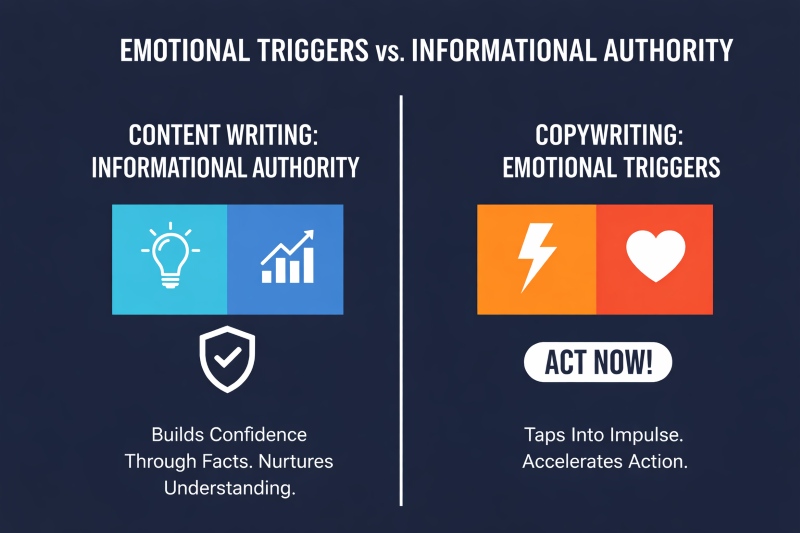
Copywriting often leans heavily on emotional triggers to drive action. Specialists understand that most buying decisions are influenced by feelings first and logic second. In fact, studies show that roughly 80% of buying decisions start with an emotional impulse, with logic justifying it later.
So, when I say “PLEASE hire me,” It means I’m not a good copywriter cause life is unfair and I should get used to it. But the thing is, copywriters craft messages around urgency, scarcity, simplicity, and benefit framing to tap into this instinct.
Content writing, by contrast, prioritizes informational authority and clarity. The goal is not necessarily to trigger emotion but to build confidence through facts, real examples, and helpful guidance.
While great content can evoke emotion, it does so indirectly by earning the reader’s trust over time rather than pushing a decision in the moment. This difference in emotional strategy mirrors the underlying purposes: content nurtures understanding while copy accelerates action.
5. Metrics of Success: Engagement vs. Conversion
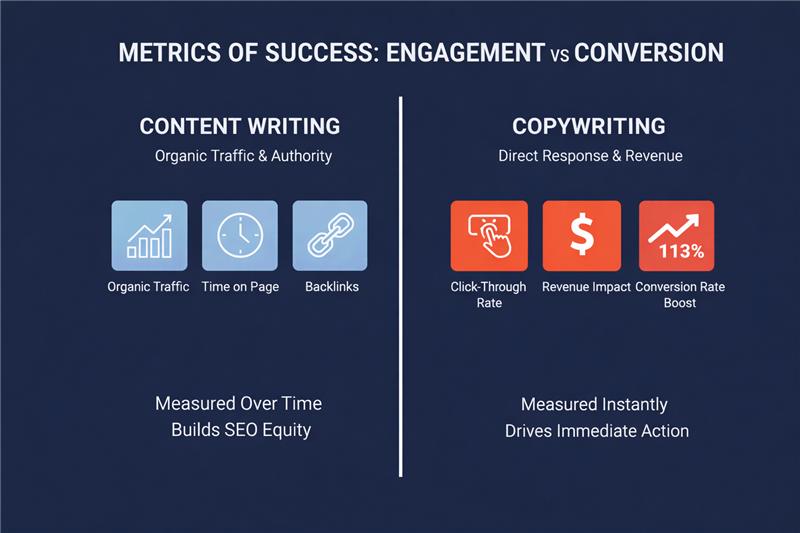
Because the purposes differ, so do the metrics by which we judge success. In content writing, performance is measured by metrics such as organic traffic, time on page, backlinks, and engagement. A piece of content that continues to draw readers months after publication is considered successful because it builds SEO equity and authority.
Copywriting metrics look very different. Copy is judged by direct response indicators, conversion rates, click-through rates, lead form submissions, and revenue impact. Unlike content, the success of copywriting can often be measured almost instantly after publication or launch.
A great headline or CTA can improve engagement and drive measurable growth quickly, in some cases increasing conversion by as much as 113% when optimized effectively. This divergence in measurement reflects the roles they play in the broader marketing ecosystem.
6. SEO Role: Ranking vs. Conversion Support
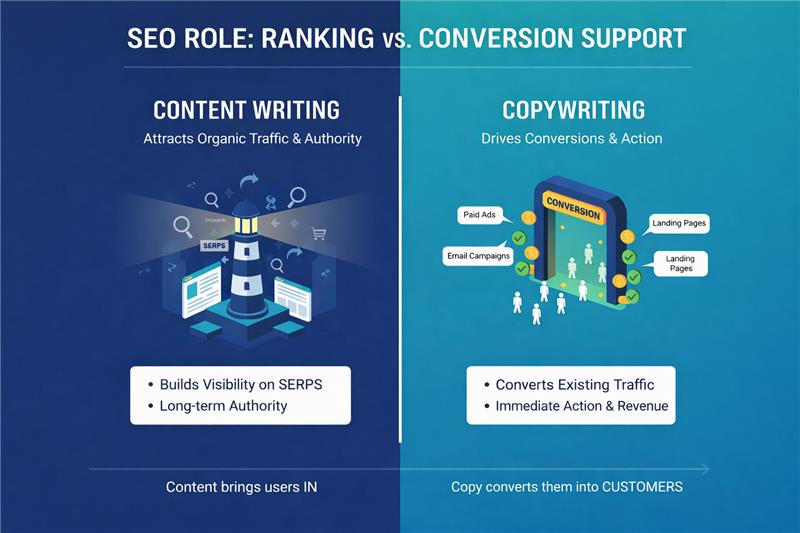
SEO benefits both disciplines, but it plays a bigger strategic role in content writing than in copywriting. Content aims to rank on search engines, attract organic traffic, and build topical authority over time. It does this by covering keywords comprehensively and satisfying a broad range of user queries, which in turn encourages backlinks and higher rankings.
Copywriting also uses SEO principles, but its focus is not rank. Copy’s primary role is to convert the visitors you already have, whether they arrived through search, paid ads, or email campaigns. In short, content writing builds visibility on search engine results pages, while copywriting drives conversions from that visibility.
This reinforces why a strategic marketing plan needs both: one brings users in, the other helps convert them into leads or customers.
7. Long-Term vs. Short-Term Impact
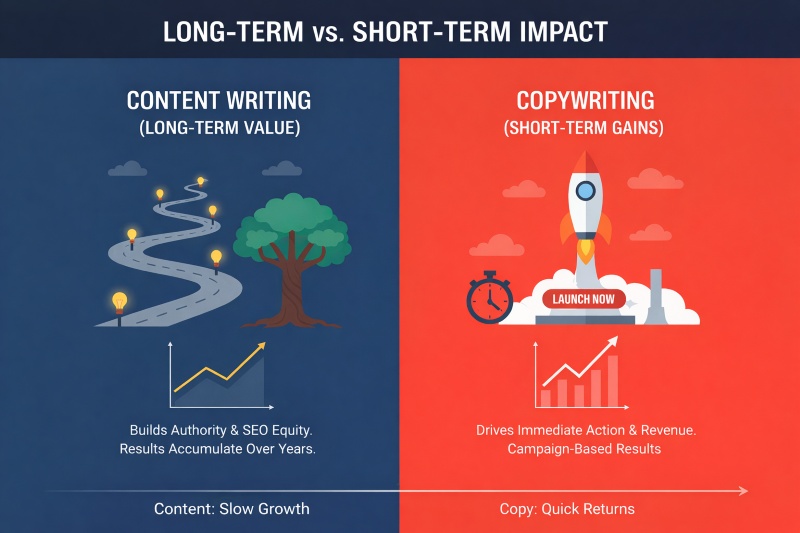
Finally, content writing and copywriting differ in time horizon. Content writing is a long game. A well-crafted guide or article may continue generating traffic and authority for years. This is why many organizations commit to consistent content calendars and topic clusters since they know results accumulate over time.
Copywriting, by contrast, is often tied to shorter-term campaigns or promotions where timing matters. A sales page, ad, or email sequence aims for results within a narrow window where relevance and urgency create action now. Because of this, content writing investments grow value slowly, while effective copy produces quick, measurable returns.
Both are valuable, but they operate on different timelines and deserve distinct strategies rather than interchangeable applications.
Buyer Journey: Where Each One Fits
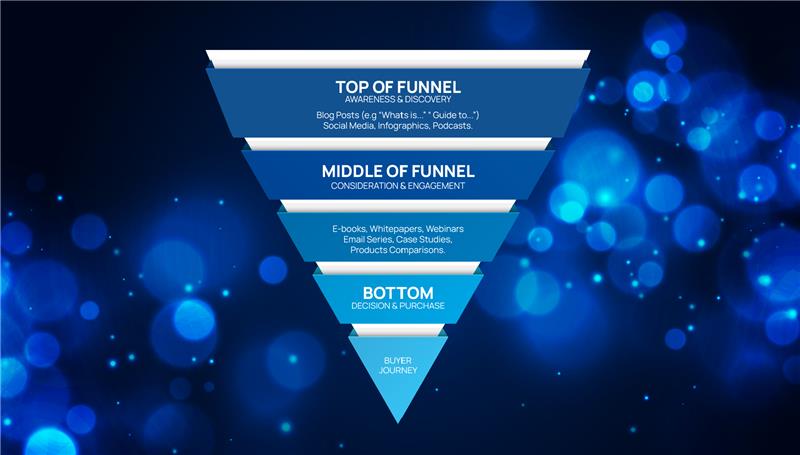
Awareness Stage: The Role of Content Writing
So, here’s where all users start. Although they don’t really want to buy yet. But they do need to understand. They’ll be asking questions, searching definitions, comparing ideas, and trying to make sense of a problem they’ve just realized exists. This stage is owned almost entirely by content writing.
Content writing introduces the problem, but the solution directly. Blogs, guides, explainers, and educational articles help users name their pain points and understand what’s actually happening. At this stage, trust matters more than persuasion. According to HubSpot, 88% of buyers research online before making a purchase decision. This makes educational content the first touchpoint for most journeys.
Consideration Stage: A Blend of Content and Copy
Once users understand the problem, they move into comparison mode. They start evaluating options, solutions, providers, and approaches. This is where content writing and copywriting overlap.
Content still plays a role by offering deeper insights, such as comparisons, case studies, and how-to guides. But copywriting quietly enters the picture. Messaging here is more structured, benefits are highlighted, and value propositions are emerging.
At this stage, users want clarity. They need proof, examples, and reassurance. According to Demand Gen Report, 47% of buyers consume three to five pieces of content before engaging with a sales representative.
Decision Stage: The Role of Copywriting
The user is now ready to act. They know the problem and have compared solutions. What they need is confidence. This stage belongs to copywriting.
Landing pages, sales pages, email campaigns, CTAs, and product descriptions focus on one thing: action. Copywriting reduces friction, answers final objections, and makes the next step feel obvious.
Landing pages with clear, focused copy can increase conversion rates by over 30%.
Future Trends in Content Writing and Copywriting
AI Assistance
AI is no longer optional. Writers use tools to speed up research, structure ideas, and optimize drafts. That said, AI supports writing. It does not replace judgment, experience, or originality. Human editing and intent still decide quality.
Search Intent Evolution
Search engines are shifting from keyword matching to intent matching. Content that genuinely answers a question performs better than content stuffed with phrases. Writers focus more on why someone is searching, not just what they type.
Google E E A T
Experience, Expertise, Authoritativeness, and Trust are also the main components of your content. Google prioritizes content written by people who know the subject. First-hand insights, examples, and credibility signals matter more than length.
Conversion Focused Content
The line between content writing and copywriting keeps blurring. Informational content is now expected to naturally guide users toward action. Helpful content that also converts is becoming the standard.
Human First Writing
Generic content is losing visibility. Readers and algorithms prefer writing that sounds natural, opinionated, and experience-driven. Human tone, clarity, and authenticity are becoming competitive advantages.
Frequently Asked Questions
What type of writing is most in demand?
SEO driven content writing and conversion-focused copywriting both remain in high demand. Brands need traffic and results, not one or the other.
Is ChatGPT taking over copywriting?
No. AI assists with speed and ideation, but strong copy still requires strategy, psychology, and a deep understanding of the brand. AI lacks context and intent.
What qualifications do I need to be a copywriter?
No formal degree is required. Strong writing skills, understanding buyer psychology, and real portfolio work matter more than certifications.
Can a content writer become a copywriter?
Yes. Many copywriters start as content writers. The shift requires learning persuasion, sales funnels, and conversion strategy.
Which is better, a copywriter or a content writer?
Neither is better. They serve different purposes. Content builds trust and visibility. Copy turns that trust into action.
Conclusion
So, content writing vs. copywriting isn’t a battle over which is better. It is about understanding when and why each one exists. Content writing builds awareness, authority, and trust. It answers questions, explains ideas, and educates readers without pressure. Copywriting steps in when clarity already exists and a decision needs to be made. It nudges, persuades, and converts.
Most successful brands do not choose one over the other. They use both, intentionally. Content brings people in. Copy moves them forward. When these two work together, the result is not just traffic or clicks, but informed users who feel confident taking the next step.
If you understand the difference, you write with purpose. And purpose is what turns words into results.