More files, more client intake, more document review, without inflating overheads. This pressure is precisely what has made a remote legal assistant service a normal staffing solution. This guide explains what remote legal assistants can expect to do, the differences between outsourcing legal support and employing in-house legal assistants, and what to consider when deciding to hire a legal support provider.
Outsourcing legal assistant services provides law firms with the opportunity to hire a skilled legal support professional who is skilled without the cost of hiring a legal assistant to work in the office. Whether it’s managing administrative tasks, handling documents, coordinating with clients, or managing case workflow, remote legal assistants can carry out routine responsibilities, freeing up time for lawyers to concentrate on more complex legal matters.
This guide will explain what a remote legal assistant does, outsourced legal assistant and why it’s helpful, and some things that law firms should think about when choosing their service provider.
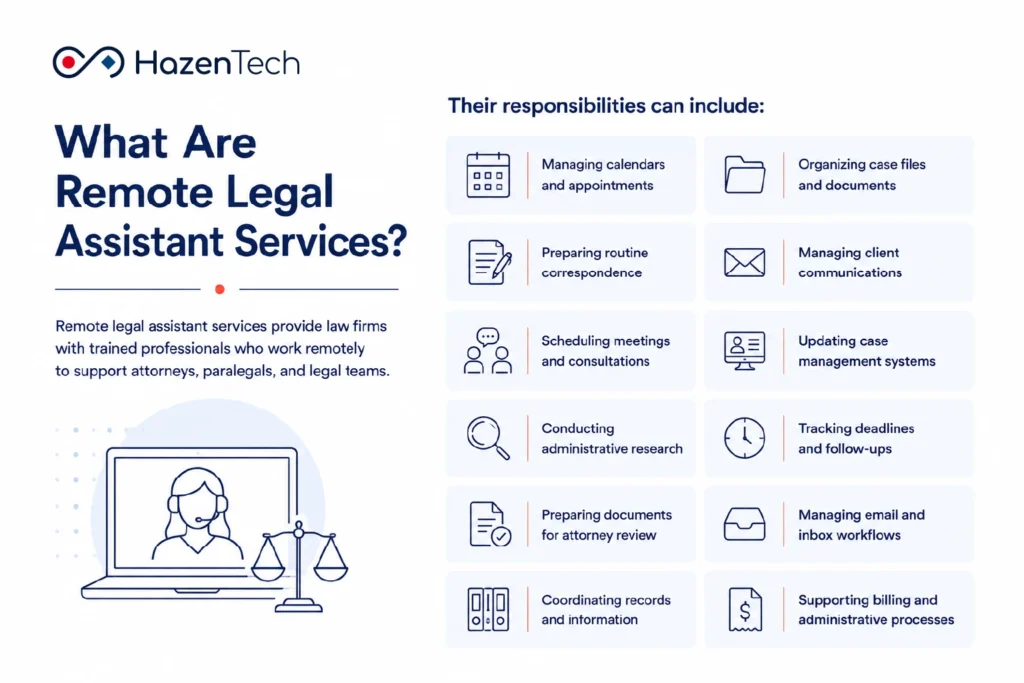
What Are Remote Legal Assistant Services?
A remote legal assistant is a professional who works in an administrative, clerical, and/or paralegal-adjacent role for a law firm but is not located at the firm’s office. For some engagements, this may involve a team of one dedicated assistant working firm hours, or a team of many, provided by a legal process outsourcing (LPO) provider, that can be scaled up and down with changes in caseload. The tasks are ones many of us are very familiar with in a law practice: Calendar management and calendar preparation, client intake and scheduling, correspondence, document preparation, e-filing, medical record retrieval, and basic case file organization. Where and how the firm pays for it is what changes this is.
Common Tasks Handled by Remote Legal Assistants
- Managing calendars and appointments
- Organizing case files and documents
- Preparing routine correspondence
- Managing client communications
- Scheduling meetings and consultations
- Updating case management systems
- Conducting administrative research
- Tracking deadlines and follow-ups
- Preparing documents for attorney review
- Managing email and inbox workflows
- Coordinating records and information
- Supporting billing and administrative processes
- Common Tasks Handled by Remote Legal Assistants
The exact scope of work depends on the firm’s needs and the service provider’s capabilities.
What Does a Remote Legal Assistant Do?
The fact that law firms are always trying to do more with less and receive more filings, more intake, and more document reviews, without adding overhead, is a constant challenge. For this reason, remote legal assistant services have progressed from a cost-cutting experiment to a staffing method that is in the mainstream. This guide will outline the responsibilities of a remote legal assistant, the pros and cons of outsourcing a legal assistant, and what to expect from a legal assistant provider.
Administrative Support
Remote assistants can manage calendars, schedule appointments, organize meetings, prepare correspondence, and handle routine administrative tasks. This helps attorneys spend less time managing operational details.
Document Management
Lawyers deal with many pleadings and correspondence, medical records, discovery of documents, contracts, etc. Legal assistants can organize files, maintain naming conventions, update folders, and assist with the ease of document retrieval from a remote location.
Client Communication
Remote legal assistants can help manage routine client communications, schedule calls, send approved updates, and route questions to the appropriate team member. This can improve responsiveness without requiring attorneys to personally handle every administrative interaction.
Case Management Support
Assistants can help with updating case management systems, keeping track of important information, keeping task lists, and tracking workflows. These duties help to maintain up-to-date and orderly case information.
Calendar and Deadline Management
Failure to meet deadlines can cause a lot of issues for your legal team. You can keep calendars, track appointments, keep track of deadlines assigned to them, and send reminders, as per the firm’s procedures, from a distance.
Records Coordination
Records may be cumbersome to gather and manage personal injury and other litigation practices. Medical records, bills, correspondence, and other case-related paperwork can be coordinated by a remote legal assistant.
In-House Hire vs. Outsourced Remote Support
Typically, the comparison is limited to three factors: cost, flexibility, and ramp-up time. An in-house hire is a full-time person who is paid a salary and benefits, has payroll taxes paid, and incurs office overhead, as well as the weeks it takes to recruit, interview, and train a person to become productive.
The outsourced remote legal assistant, on the other hand, is already trained on legal workflows and can also be increased in case of a busy litigation season or reduced in the event of a slow quarter, without the firm having to pay for having a large number of legal assistants who are not doing anything.
The compromise is control. They can be supervised in the office and are integrated into the company culture. When outsourcing, they must have proper workflows, access to systems, and a provider that you trust to keep you up to date with the process, without needing to check in with them every day.
What to Look For in a Remote Legal Assistant Provider
- Experience specific to your practice area (personal injury intake differs from real estate closings)
- Documented data security and confidentiality protocols, including compliance with relevant privacy standards
- A track record you can verify, not just marketing claims ask for references or third-party reviews
- Clear communication cadence and a named point of contact, not a rotating pool of strangers
- Flexible engagement terms so staffing can flex with your caseload
Why Law Firms Outsource Legal Assistant Work
Outsourcing can give law firms greater flexibility when internal teams are stretched thinly. It allows firms to bring support quickly during busy periods without committing to a full-time hire. This makes it easier to manage costs while keeping casework moving on schedule.
Reduce Administrative Work
Attorneys often spend considerable time on tasks that do not require their legal judgment. Delegating administrative responsibilities allows attorneys and paralegals to concentrate on case strategy, client representation, and other higher-value work.
Control Operating Costs
Hiring an in-house employee involves more than salary. Firms may also need to account for benefits, office space, equipment, training, payroll administration, and other employment costs.
Outsourcing can provide access to legal support without requiring the firm to build the same level of internal infrastructure.
Scale Support When Needed
Workloads can change quickly. A firm may experience a sudden increase in cases, discovery of materials, records, or administrative tasks.
Outsourced support can provide additional capacity without requiring the firm to make a permanent full-time hire for a temporary increase in workload.
Improve Workflow Efficiency
When routine tasks are assigned to dedicated support professionals, attorneys can spend more time on work that directly affects case outcomes and client service.
Access Specialized Support
Outsourcing providers may have professionals with experience supporting specific practice areas and legal workflows. This can help firms with access capabilities that may be difficult to develop internally.
What Tasks Should You Outsource?
Not every responsibility should be outsourced. The best candidates are generally repetitive, process-driven, time-consuming, or administrative tasks that can be completed according to established procedures.
Common tasks include:
- Email management
- Calendar management
- Client intake support
- Document organization
- Case file maintenance
- Data entry
- Records coordination
- Appointment scheduling
- Deadline tracking
- Routine correspondence
- Database updates
- File indexing
- Administrative follow-up
Firms should carefully define which tasks require attorney judgment and which can be delegated under established procedures.
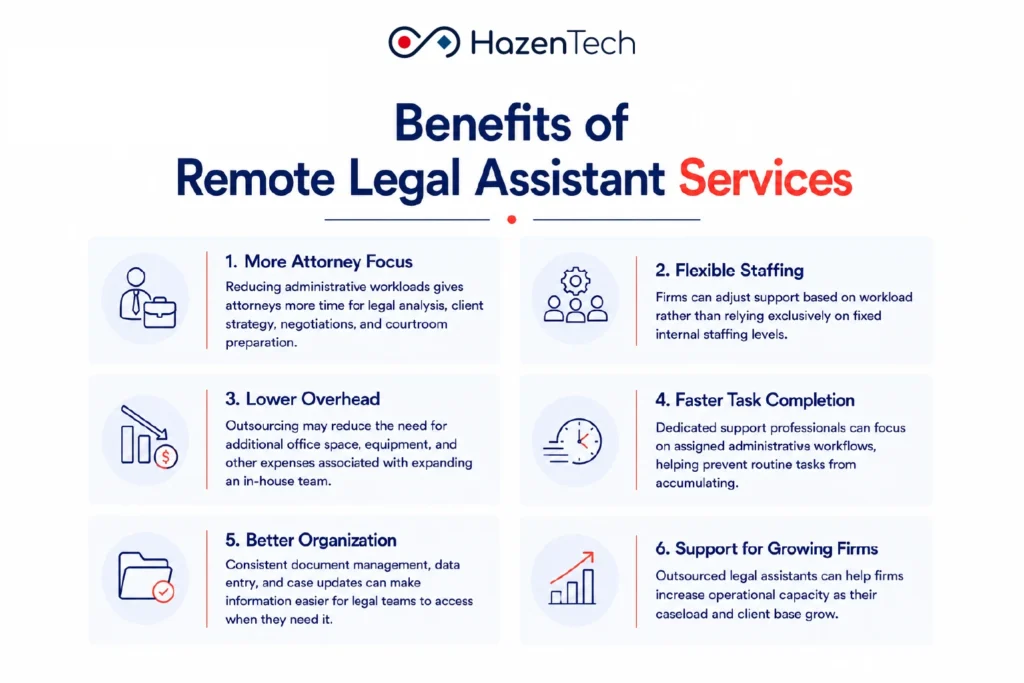
Benefits of Remote Legal Assistant Services
1. More Attorney Focus
Reducing administrative workloads gives attorneys more time for legal analysis, client strategy, negotiations, and courtroom preparation.
2. Flexible Staffing
Firms can adjust support based on workload rather than relying exclusively on fixed internal staffing levels.
3. Lower Overhead
Outsourcing may reduce the need for additional office space, equipment, and other expenses associated with expanding an in-house team.
4. Faster Task Completion
Dedicated support professionals can focus on assigned administrative workflows, helping prevent routine tasks from accumulating.
5. Better Organization
Consistent document management, data entry, and case updates can make information easier for legal teams to access when they need it.
6. Support for Growing Firms
Outsourced legal assistants can help firms increase operational capacity as their caseload and client base grow.
How Remote Legal Assistant Outsourcing Works
A successful outsourcing arrangement typically follows a structured process.
Step 1: Identify Your Workload
Start by determining which tasks consume the staff’s time. Review recurring administrative activities and identify responsibilities that can be handled remotely.
Step 2: Define the Scope of Work
Create a clear list of responsibilities, expected turnaround times, workflows, software requirements, and communication procedures.
Step 3: Select a Service Provider
Evaluate providers based on their legal experience, staffing capabilities, security practices, communication processes, and ability to support your firm’s practice area.
Step 4: Establish Secure Access
The provider should follow appropriate security procedures for accessing case management platforms, document systems, email accounts, and other legal technology.
Access should be limited according to each professional’s responsibilities.
Step 5: Create Workflows
Document on how tasks should be assigned, completed, reviewed, escalated, and tracked. Clear workflows reduce confusion and make outsourced support easier to manage.
Step 6: Monitor Performance
Use measurable standards such as turnaround time, accuracy, completed tasks, responsiveness, and quality-control results to evaluate performance.
How to Choose a Remote Legal Assistant Service
Choosing the lowest-cost provider is not always the best approach. Law firms should consider the overall quality, reliability, and security of the service.
Legal Industry Experience
Look for providers that understand legal terminology, case workflows, confidentiality requirements, and the operational demands of law firms.
Data Security
Legal teams handle confidential client information. Ask how the provider protects data, manages access, secures communications, and handles confidential documents.
Qualified Professionals
Understand who will perform the work and whether the professionals have relevant legal support experience and training.
Communication
Reliable communication is essential when working with a remote team. Establish clear channels for assignments, questions, updates, and urgent matters.
Quality Control
Ask how work is reviewed before completion and how errors are identified and corrected.
Scalability
Your firm’s needs may change. Choose a provider that can increase or decrease support as your workload changes.
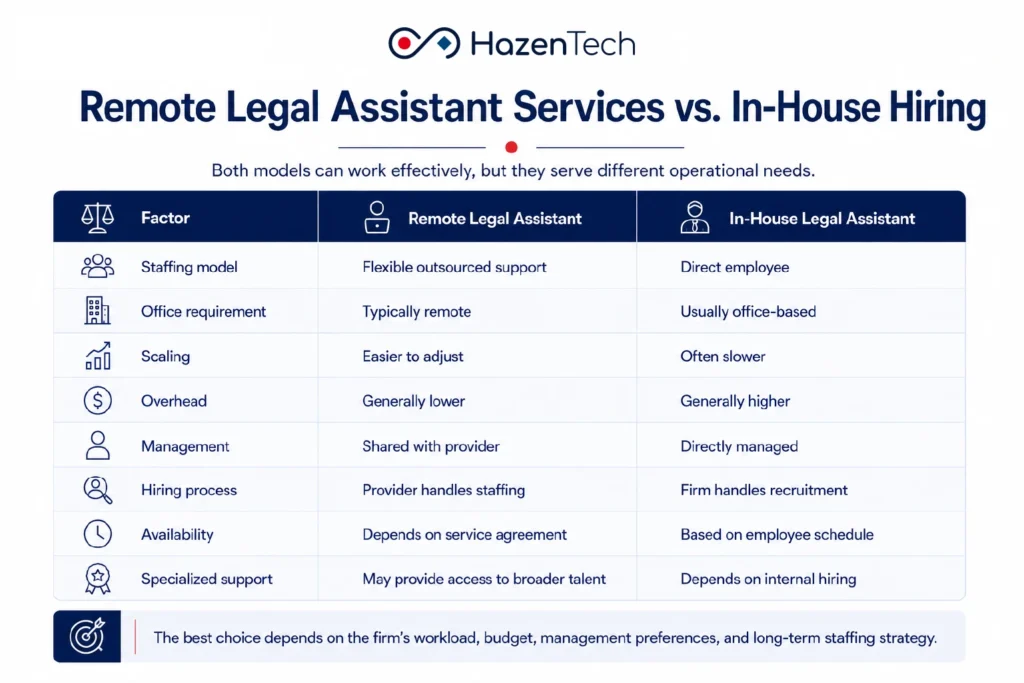
Remote Legal Assistant Services vs. In-House Hiring
Both models can work effectively, but they serve different operational needs.
Factor | Remote Legal Assistant | In-House Legal Assistant |
Staffing model | Flexible outsourced support | Direct employee |
Office requirement | Typically remote | Usually office-based |
Scaling | Easier to adjust | Often slower |
Overhead | Generally lower | Generally higher |
Management | Shared with provider | Directly managed |
Hiring process | Provider handles staffing | Firm handles recruitment |
Availability | Depends on service agreement | Based on employee schedule |
Specialized support | May provide access to broader talent | Depends on internal hiring |
The best choice depends on the firm’s workload, budget, management preferences, and long-term staffing strategy.
Common Mistakes to Avoid
Although outsourcing legal support can be a lifesaver in some respects, many companies do not see the benefits that they had anticipated, and in most cases, the reason for this is not because of the failure of outsourcing itself, but because the outsourcing was rushed through.
Doing Outsourcing without Stated Processes.
One of the most frequent mistakes is turning over the job without explaining how it is to be completed. A remote assistant can’t follow conventions if a firm cannot explain them in writing, nor can it follow escalation rules if the firm cannot. The outcome is typically inconsistent with the output that is assigned as the provider’s fault if it doesn’t happen because it’s missing because there is no workflow.
Evaluating a product or service solely by its price.
While it may be the most affordable, it is also the one that can be the most expensive when all the rework, delayed deadlines, and retraining are taken into account. Over the relationship, other factors, such as your experience in the area, data security practices, reliability and proven quality, are more important than the cost of the initial day.
Giving Excessive Access
The remote employee’s job should be considered as a bare bones job, meaning that they are only allowed to access what they need to do their job. Allowing wide access to case management systems, billing or client files “to be safe” is a risky approach if there is a problem, and it is one of the first things that will be noticed during a security review. Access needs to be focused on the task and re-evaluated as responsibilities of change.
The school has not developed adequate quality standards.
Quality is allowed to meander, or fade, if there is no standard of what is “done well. Companies that are most successful with outsourced support typically have a review process, whether it be spot checking a sample of the work, tracking the number of errors or having a staff member sign off on the documents before they leave the office. If not, issues are likely to arise once they’ve done damage.
Poor Communication
Accessibility problems are more likely to occur for remote arrangements due to poor communication rather than a lack of skills. Companies require a clear path to define work, a mechanism to ask questions within 2 days, and a clear escalation procedure should an urgent matter arise. Ambiguity is the reason that deadlines are missed here.
Is Outsourced Legal Support Right for Your Firm?
Outsourcing is most effective for companies with recurring, high-volume administrative tasks those that process a ton of paperwork, such as personal injury firms- or those that are moving into new markets and don’t need to add staff first. It does not make a lot of sense for complex, judgmental tasks that actually need the presence of an attorney in the courtroom.
Rather than replacing legal staff, most companies who choose to outsource legal support use the outsourced legal assistant to handle the repetitive and time-consuming tasks, thus allowing their in-house legal staff to bill the client and do more time-consuming, client-facing tasks.
Getting Started
With over a decade of legal process outsourcing experience for firms nationwide and a 99% accuracy record, Hazen Tech is recognized as Florida’s best legal process outsourcing company by Clutch in 2024. A Microsoft-Certified Partner, Hazen Tech brings together certified legal support personnel and the technology infrastructure that law firms require to ensure the security and uniformity of their data and workflows. Companies that are interested in outsourced support can take advantage of free 7-day trials to determine if a remote legal assistant is the right option for their working environment prior to committing.
Frequently Asked Questions
What is a remote legal assistant?
A remote legal assistant is a professional who provides administrative and organizational support to attorneys and legal teams from an off-site location. Remote Legal Assistant Services can help firms manage routine tasks without adding another in-house employee.
Can a remote legal assistant work with a law firm’s existing team?
Yes. A remote legal assistant can work alongside attorneys, paralegals, office managers, and other staff when responsibilities and communication procedures are clearly defined. Remote legal staff can become an extension of an existing legal team while handling assigned administrative and workflow tasks.
What tasks can a remote legal assistant handle?
Common responsibilities include scheduling, document organization, client communication support, case management updates, email management, records coordination, data entry, and deadline tracking. Depending on the firm’s needs, on-demand legal assistants can also provide flexible support during periods of increased workload.
Is outsourcing legal assistant work secure?
It can be, provided that the firm selects a provider with appropriate security controls, confidentiality procedures, access restrictions, and data protection practices. Firms should evaluate these safeguards before engaging outsourced legal support or other remote services.
What is the difference between a legal assistant and a paralegal?
Legal assistants generally focus on administrative and organizational responsibilities, while paralegals typically perform more substantive legal support to work under attorney supervision. A virtual legal assistant may be a suitable option when a firm primarily needs remote administrative and operational assistance.
Can small law firms use remote legal assistants?
Yes. Remote support can be particularly useful for smaller firms that need additional capacity without immediately expanding their internal staff. Legal process outsourcing services can provide flexible access to support professionals while helping firms manage administrative workloads and operational costs.